Best Projector in Pakistan (2026): Price Guide & Buying Tips
Introduction
Finding the best projector in Pakistan in 2026 is less about buying the brightest box on the shelf and more about matching the projector to the room and the job. A family wanting movie nights, a teacher running slides in a bright classroom, an office holding client meetings and a student carrying a mini projector between hostel rooms all need very different machines, and prices typically range from around Rs 15,000 to Rs 150,000 (check the seller for the current price).
Projectors have become a common sight across Pakistan. Families set one up for PSL and World Cup matches, schools use them for lectures, offices run presentations on them, and a decent projector now gives you a 100-inch picture for less than a large television.
The catch is that the spec sheet can mislead you. A brightness number measured in a dark lab means little in a sunny lounge, a cheap projector can quote a resolution it does not truly deliver, and a projector with no local warranty can turn into a paperweight when its lamp dies. This guide covers the five main types sold in Pakistan and explains lumens, resolution, throw distance and lamp life in plain language.
Quick Picks
- Best for small rooms and travel: A budget mini or portable projector.
- Best for movie nights: A home cinema projector with full HD resolution.
- Best for meetings and classes: A bright office or business projector.
- Best for tight spaces: A short-throw projector placed close to the wall.
- Best all-rounder: A smart Android projector with built-in apps.
Budget Mini and Portable Projectors
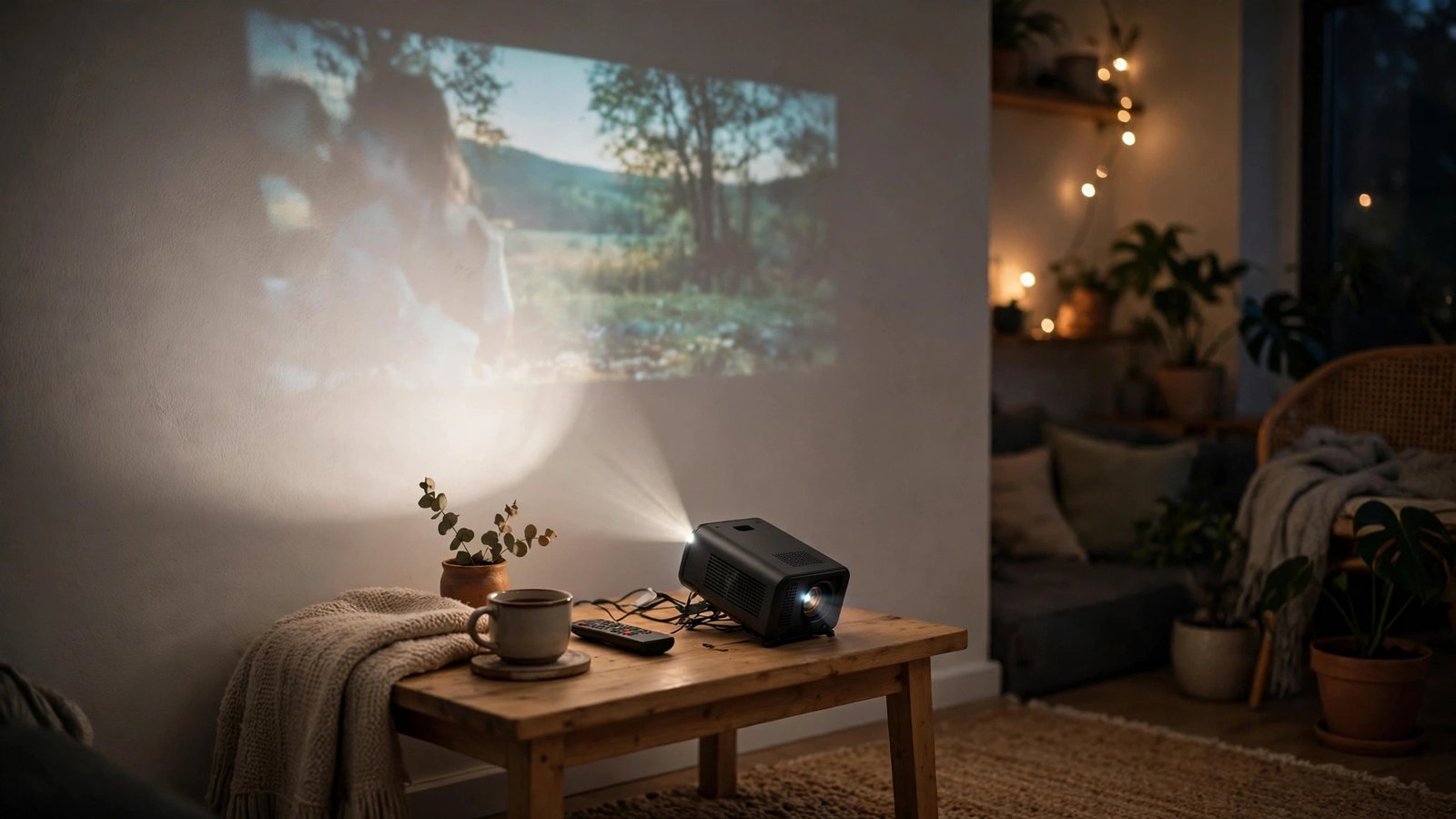
A budget mini projector is the cheapest way into big-screen viewing, and for many first-time buyers it is the right place to start. These are small, light machines — some no bigger than a lunchbox — with a built-in speaker, a simple menu and a price a student or a family can afford. Many run on a built-in battery or a power bank, so you can carry one to a rooftop, a friend’s house or a classroom.
The picture on a mini projector is modest: fine in a dark room, but washed out when daylight comes through the window, and the resolution is often lower than the box suggests. Brightness is the weak point — most mini models put out far less light than a full-size projector — so they suit night viewing, not afternoon matches in a bright lounge.
- Pros: Lowest prices, light and easy to carry, built-in speaker and battery on many models, quick to set up anywhere.
- Cons: Dim picture in daylight, lower true resolution, small speaker sound, short lamp or LED life on the cheapest models.
Home Cinema Projectors for Movie Nights
A home cinema projector is the type most families actually want: a proper big-screen machine with full HD resolution, decent contrast and a picture that holds up on a large screen. Detail is sharper, blacks are deeper in dark scenes, and the picture stays watchable at 100 inches and beyond. Most models connect to a set-top box, a laptop or a streaming stick, and pair well with a soundbar or home theatre speakers.
Setting one up takes a little planning: a dark or dim room, a clear throw distance of a few metres, and a flat white wall or a screen. A ceiling mount keeps it out of the way and stops anyone walking through the beam. Home cinema models are brighter than mini projectors, but they still work best after sunset or with curtains drawn.
- Pros: Sharp full HD picture on a very large screen, good contrast for films, works with streaming sticks and soundbars, real cinema feel at home.
- Cons: Needs a dark room and several metres of space, costs far more than a mini projector, fixed setup is less portable.
Office and Business Projectors
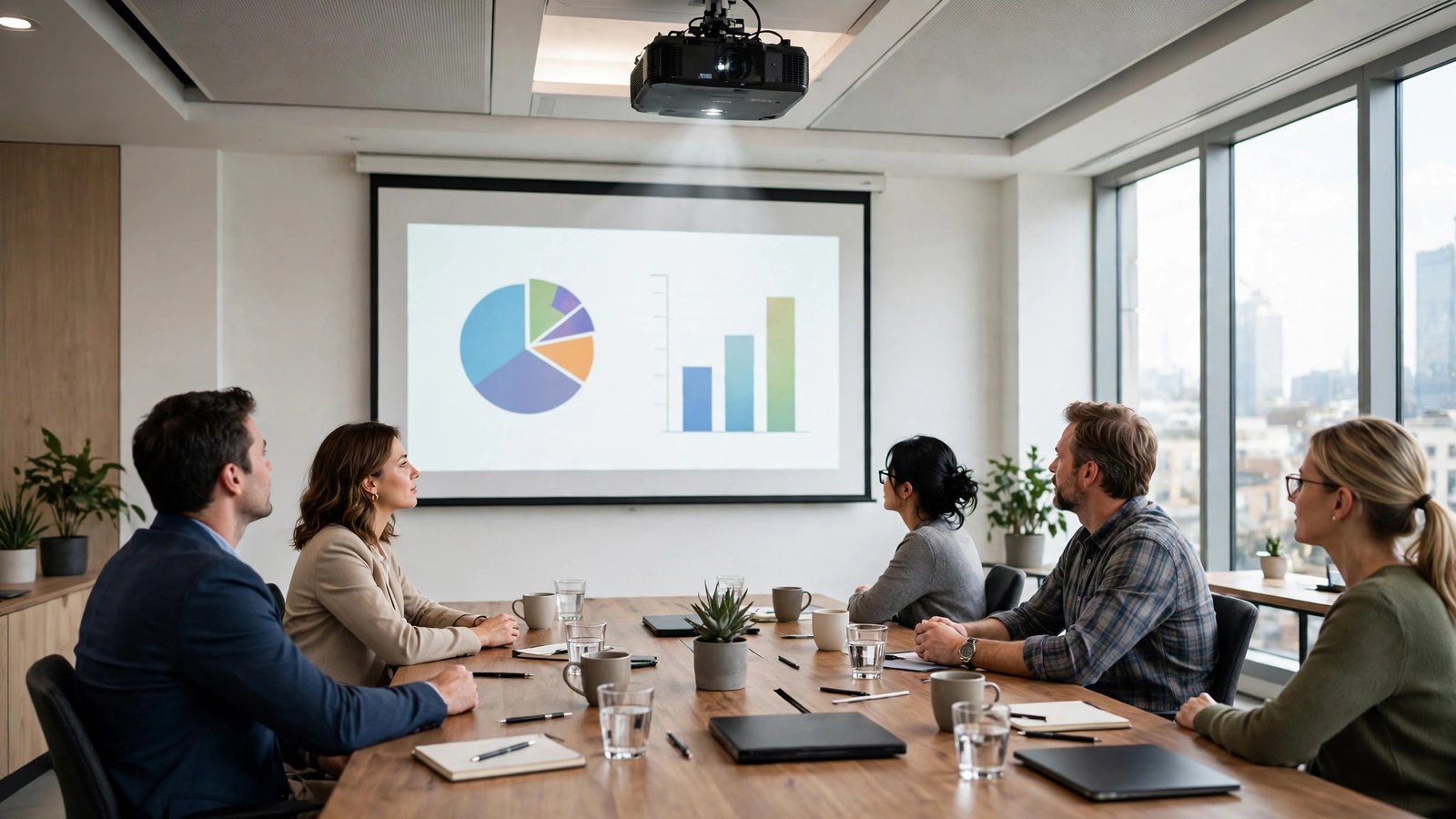
An office or business projector is built for one job: slides, spreadsheets and documents that stay readable with the lights on. Brightness matters more here than contrast, so these models put out far more light than a home cinema projector. Text stays crisp at the back of a meeting room, and a whiteboard or a light-coloured wall can work as the screen in a pinch.
Most business projectors offer HDMI, USB and wireless screen sharing, so a laptop, a phone or a tablet connects in seconds, and they are built to run for hours a day, which matters for training centres, schools and offices. The trade-off is that films look flatter on them than on a home cinema model, so buy a business projector for work, not for movie nights.
- Pros: Bright enough for lit rooms, sharp text and slides, quick connections for laptops and phones, built for daily use.
- Cons: Picture quality for films is only average, fan noise can be noticeable, usually needs a table or ceiling mount.
Short-Throw Projectors for Tight Spaces
A short-throw projector solves the biggest problem of a normal projector: the distance it needs. A regular projector sits several metres from the screen, but a short-throw model can sit a metre or less away and still fill a large screen — the right choice for a small lounge, a bedroom or a classroom with desks in the way.
The picture quality is usually on par with a standard projector, and the close placement means the light is rarely blocked by someone standing up. The price is higher than a basic model of the same brightness, and placement matters: the projector must sit level and square to the wall, or the picture comes out lopsided. If your room is short on space, a short-throw projector is often the only way to get a big picture at all.
- Pros: Big picture from very close to the wall, no one walks through the beam, suits small rooms and classrooms.
- Cons: Costs more than a standard projector, placement must be precise, picture can distort if set up at an angle.
Smart Android Projectors with Built-in Apps
A smart Android projector is a projector with a streaming device built in. It runs apps such as YouTube and Netflix straight from the projector, connects to Wi-Fi, and often has Bluetooth for a speaker or headphones. There is no laptop, no streaming stick and no extra cable — switch it on, pick an app and start watching.
The built-in system is convenient, but check before you buy: some smart projectors run an older Android version, some apps may not be available or may not run in full HD, and the built-in speaker is usually small, so a Bluetooth speaker makes a real difference. For a family that wants the simplest possible setup, a smart projector is the easiest route to a big screen.
- Pros: Built-in apps and Wi-Fi, no extra streaming stick needed, Bluetooth for speakers and headphones, simple to use.
- Cons: Apps and software can age quickly, built-in speaker is weak, some apps may not run in full quality.
Price Guide: What a Projector Costs in Pakistan
Prices for a projector in Pakistan typically range from around Rs 15,000 to Rs 150,000 (check the seller for the current price). At the lower end, roughly Rs 15,000 to Rs 35,000, sit budget mini and portable projectors — enough for casual movie nights in a dark room. The middle band, around Rs 35,000 to Rs 80,000, is where most buyers should look: home cinema and smart Android projectors with full HD resolution and proper connectivity, the range that suits family lounges and bedrooms.
Above Rs 80,000, towards Rs 150,000, sit bright office projectors, short-throw models and higher-end home cinema machines with better contrast and sharper lenses. Three things move the price most: brightness in lumens, true resolution, and the light source — LED models last longer, while lamp models are often brighter for the price but need a lamp replacement after a few thousand hours. A screen, a mount and a soundbar are extra, so keep some budget aside for them.
Buying Tips for Pakistani Buyers
Start with your room, not the spec sheet. Measure the distance from the projector to the wall, check how much daylight the room gets, and decide whether the projector will stay in one place or travel. A bright room needs a brighter projector, a small room needs a short-throw model, and a fixed lounge suits a home cinema machine. Ignore a big brightness number measured in a dark lab — ask the seller to show the picture in normal room light.
Plan for load-shedding before you buy. A projector draws real power, so pair it with a UPS that can carry it through a short outage, and never cut the power while the fan is still cooling the lamp — switching a lamp projector off at the wall while it is hot shortens the lamp’s life. Keep the projector in a cool, dust-free spot, clean the air filter and vents regularly, and keep it away from direct sunlight and kitchen heat — dust and heat kill projectors fastest in Pakistani summers.
Buy from a seller who tests the projector in front of you and gives a written warranty — lamp life is often excluded or limited, so ask what it covers. Check that spare lamps, remote controls and power adapters are available locally. Use a flat white wall or a proper screen, and keep the receipt and the box in case the unit needs service.
Frequently Asked Questions
How many lumens do I need for a projector?
Lumens measure brightness — more lumens means a brighter picture. A modest brightness works fine in a dark room at night; a lounge with daylight coming in, or a classroom with the lights on, needs a much brighter projector. As a rule, buy brighter than you think you need, because a picture that is too dim cannot be fixed.
Can I use a projector in daylight?
Yes, but only a bright projector with the curtains drawn gives a watchable picture in daylight — a budget mini projector will look washed out in a sunny room. For daytime viewing, pick a bright office-style projector, use blackout curtains, and project onto a white wall or screen.
LED or lamp — which lasts longer?
LED projectors usually last far longer, often tens of thousands of hours, and they switch on and off instantly with no warm-up. Lamp projectors can be brighter for the price, but the lamp wears out after a few thousand hours and a replacement costs real money. If you watch daily, an LED model usually works out cheaper over time.
Do I need a screen, or is a white wall enough?
A smooth, flat white wall works well and costs nothing, which is how most buyers start. A proper screen gives a brighter, more even picture with better contrast. A textured or coloured wall is the worst option — it softens the picture and shifts the colours.
Where should I buy a projector in Pakistan?
Buy from a reputable seller — an authorised dealer, a well-rated online marketplace seller on Daraz, or a specialist electronics shop — who tests the projector before handing it over and gives a written warranty. Check the seller’s ratings and after-sales support first, and confirm spare lamps and parts are available. Avoid grey-market deals with no warranty.
Conclusion
The best projector in Pakistan is the one that matches your room and your watching — a mini projector for portable movie nights, a home cinema model for the family lounge, a bright business projector for meetings and classes, or a smart Android projector for the simplest setup. Set your budget from the ranges in this guide, test the picture in normal room light before you pay, and plan for load-shedding and dust from the start.
For more buying guides on trending products across Pakistan, visit the product feed at https://trendz.pk/.