Best Ceiling Fan in Pakistan (2026): Price Guide & Buying Tips
Best Ceiling Fan in Pakistan (2026): Price Guide & Buying Tips
Ceiling fan price in Pakistan is one of the most searched home-appliance questions of 2026. With summer temperatures crossing 45°C in Lahore, Karachi, Multan and other cities, a ceiling fan is not a luxury — it is the one appliance that runs in almost every room, day and night, for months at a time. A good fan keeps a room livable; a bad one just pushes warm air around while eating electricity and making noise.
Any electric market — Hall Road in Lahore, Saddar in Karachi, or the small shops in your own neighbourhood — offers AC fans, DC inverter fans, remote-control models, designer fans and 30-watt energy savers. This guide explains what actually matters — air delivery, blade size, winding quality and voltage tolerance. Prices for ceiling fans in Pakistan range from Rs 6,000 to Rs 18,000.
Quick Picks
- Best overall: A 56-inch AC ceiling fan with copper winding — strong airflow, proven reliability, easy repairs anywhere in Pakistan.
- Best budget: A basic 48-inch AC ceiling fan — typically around Rs 6,000–8,000 (check the seller for the current price), good enough for a small bedroom.
- Best inverter / DC energy-saving: A DC inverter ceiling fan — uses far less electricity and keeps running smoothly on UPS or solar.
- Best for large rooms: A 56-inch or 60-inch fan with high air delivery for a big lounge or drawing room.
- Best for low-voltage areas: A DC inverter fan with a wide operating voltage range — keeps spinning steadily where voltage drops every evening.
AC Ceiling Fan
The standard AC ceiling fan is the workhorse of Pakistani homes. It runs directly on the 220-volt mains supply, and every electrician knows how to repair one. A typical AC ceiling fan in Pakistan costs around Rs 6,500–12,000 (check the seller for the current price), depending on size, brand and winding. The most common size is 56 inches, which suits most bedrooms and lounges.
Pros: Lowest upfront cost of any fan type, with spare parts in every market. Strong, proven airflow. Any local electrician can repair it, including rewinding the motor.
Cons: Uses more electricity than a DC fan — typically 70 to 80 watts at full speed. Speed drops when the voltage drops during peak hours.
Who should buy one: Anyone who wants a reliable, affordable fan for a standard room. If your area has stable voltage, an AC fan is still a sensible buy in 2026.
DC Inverter Ceiling Fan
DC inverter fans are the fastest-growing category in Pakistan, because they use far less electricity. A typical DC inverter fan draws around 30 to 35 watts at full speed, compared with 70 to 80 watts for a standard AC fan. Over a summer of running 16 to 18 hours a day, that difference shows up on the electricity bill. Many models also run on a 12-volt battery or solar, which makes them popular in load-shedding areas.
A DC inverter ceiling fan in Pakistan typically costs around Rs 9,000–16,000 (check the seller for the current price).
Pros: Uses roughly half the electricity of a standard AC fan, which matters when power tariffs keep rising. Steady speed even when voltage fluctuates, and most models keep working on UPS or solar.
Cons: Higher upfront price, so the payback through electricity savings takes a season or two. The electronic circuit board is harder to repair than a simple AC motor, and not every local electrician can fix it.
Who should buy one: Households that run fans for long hours, anyone on solar or UPS, and people in low-voltage areas.
Remote-Control Ceiling Fan
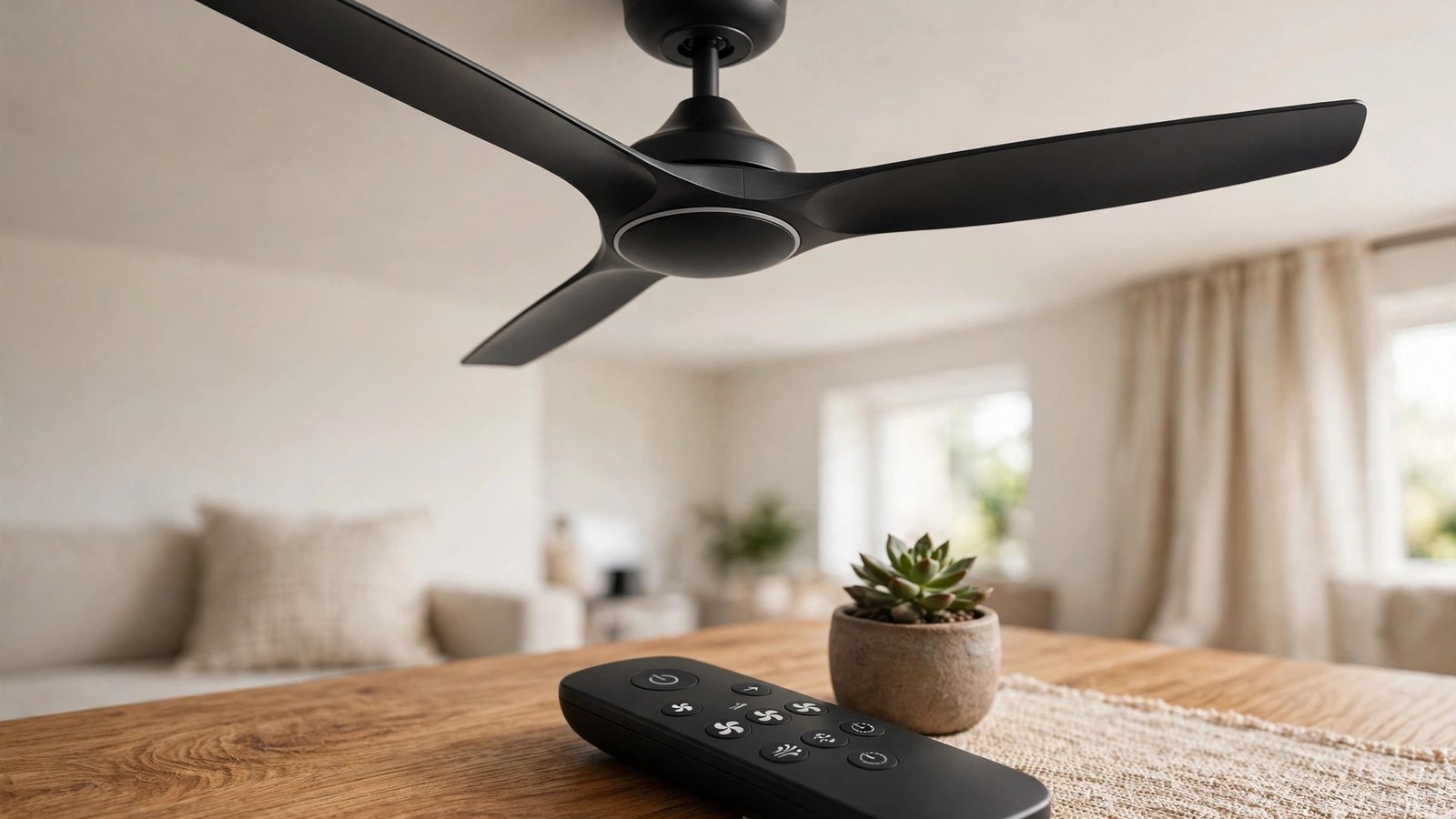
Remote-control ceiling fans are now available in both AC and DC versions, and they have become a popular choice for bedrooms and lounges. The remote lets you change the speed, switch the fan off, and sometimes set a timer — all without getting out of bed.
A remote-control ceiling fan in Pakistan typically costs around Rs 10,000–18,000 (check the seller for the current price). The price depends on whether the fan is AC or DC, the quality of the remote and receiver circuit, and the finish of the blades.
Pros: Change speed or switch off from anywhere in the room — genuinely useful at night. Timer functions switch the fan off automatically after a set period.
Cons: If the remote is lost or the receiver circuit fails, you lose speed control until it is repaired or replaced. Replacement remotes are not always available for lesser-known brands.
Who should buy one: Anyone who values convenience — bedrooms, TV lounges, and rooms used by elderly parents.
Decorative and Designer Ceiling Fan
Designer ceiling fans are built to look good as well as move air. They come in wooden finishes, matte black, metallic gold accents and curved blade designs that suit modern interiors. In new homes and renovated lounges, these fans have become a visible part of the room's decoration.
A decorative or designer ceiling fan in Pakistan typically costs around Rs 12,000–18,000 (check the seller for the current price). You are paying for the finish and design as much as for the motor.
Pros: Improves the look of a lounge or drawing room — the fan becomes a feature, not an eyesore. Often built with better bearings and balanced blades, so they run quietly.
Cons: Highest prices in the category, with much of the premium going to looks rather than airflow. Some designer models prioritise appearance over air delivery, so check the airflow before buying.
Who should buy one: Homeowners furnishing a new lounge or drawing room where the fan will be visible to guests. For a bedroom or a rented house, a standard fan usually makes more sense.

Energy-Saver 30W Ceiling Fan
The 30-watt energy-saver fan is a specific type of DC fan marketed on one promise: full-size airflow at around 30 watts of power. They became popular as electricity tariffs rose.
An energy-saver 30W ceiling fan in Pakistan typically costs around Rs 8,500–14,000 (check the seller for the current price). The range is wide because the category includes both well-made fans from established makers and cheap imitations that do not actually deliver the claimed wattage.
Pros: Very low power consumption — the main selling point, and a real one when the fan is genuinely built to the specification. Runs easily on a small UPS or a modest solar setup, which helps during load-shedding.
Cons: The "30W" claim is not always honest — some fans labelled 30 watts actually draw more, so the label alone proves nothing. Cheaper models can have weak airflow despite the low wattage.
Who should buy one: Homes with solar panels or small UPS systems, and anyone whose fan runs almost around the clock in summer.
Ceiling Fan Price in Pakistan: Price-Range Guidance
Prices for ceiling fans in Pakistan range from Rs 6,000 to Rs 18,000. Within that range, the type of fan is the biggest factor. A basic 48-inch AC fan sits at the bottom, typically around Rs 6,000–8,000 (check the seller for the current price). A standard 56-inch AC fan from a known maker usually falls around Rs 8,000–12,000 (check the seller for the current price). DC inverter fans and energy-saver models generally cost around Rs 9,000–16,000 (check the seller for the current price), while remote-control and designer fans occupy the top end at around Rs 12,000–18,000 (check the seller for the current price).
Copper winding, larger blade sweeps, a remote control and a longer warranty all push the price up, and prices differ between cities and shops.
Treat every price as approximate. Prices change with the dollar rate, copper prices and seasonal demand — fans cost most at the start of summer and often less in winter. Always confirm the final price with the seller and check what the warranty covers.
Buying Tips
Air delivery and CFM
Air delivery — usually measured in cubic feet per minute (CFM) — is the most important performance number for a ceiling fan. A good 56-inch fan should deliver airflow you can feel across the room, not just directly underneath it.
Blade sweep size
Match the blade size to the room. A 48-inch fan suits a small bedroom of around 10 by 10 feet. A 56-inch fan is the standard choice for most bedrooms and lounges. For a large lounge or hall above 16 by 16 feet, look at a 60-inch model or consider two fans.
Copper versus aluminium winding
The winding is the heart of the motor. Copper winding conducts electricity better, runs cooler and lasts longer. Aluminium winding is cheaper, runs hotter and is more likely to burn out during voltage fluctuations. Many of the cheapest fans in the market use aluminium winding, which is one reason they cost so little — and one reason they fail sooner.
Voltage fluctuation and UPS or solar compatibility
Voltage fluctuation is a daily reality in many Pakistani neighbourhoods. A fan that slows to a crawl every evening is useless. DC inverter fans handle low voltage far better than standard AC fans. If you run your home on solar panels or a UPS, a DC fan is the natural fit — it draws less power and keeps running when the mains supply is unstable.
Warranty and genuine versus copy checks
The copy-versus-genuine problem is real in Pakistani electric markets. A fan that looks identical to a known brand's model, sold at half the price, is almost certainly a copy. Copies often use thin winding, weak bearings and poor paint, and they rarely last a full summer. Protect yourself: buy from an authorised dealer or a shop you know, check that the box, warranty card and fan carry the same brand name and model number, and confirm the warranty in writing.
Frequently Asked Questions
What is the ceiling fan price in Pakistan in 2026?
Prices for ceiling fans in Pakistan range from Rs 6,000 to Rs 18,000. A basic AC fan typically costs around Rs 6,000–8,000, a standard 56-inch AC fan around Rs 8,000–12,000, and DC inverter or remote-control fans around Rs 9,000–18,000 (check the seller for the current price).
Which ceiling fan is best for load-shedding areas?
A DC inverter fan is the best choice for load-shedding areas. It uses around 30 to 35 watts, runs smoothly on a UPS or solar setup, and keeps its speed when the voltage drops.
Are DC inverter fans really worth the extra money?
For most homes, yes — if the fan runs for long hours every day. The extra upfront cost is usually recovered through lower electricity bills over one or two summers.
How do I know if a ceiling fan is genuine or a copy?
Buy from an authorised dealer, check that the brand name and model number match on the box, the warranty card and the fan itself, and confirm the warranty terms in writing before paying.
What size ceiling fan do I need for my room?
A 48-inch fan suits a small bedroom, a 56-inch fan suits most bedrooms and lounges, and a 60-inch fan or two fans suit a large hall.
Conclusion
Buying a ceiling fan in Pakistan in 2026 comes down to matching the fan to your room, your power situation and your budget. A standard AC fan remains a solid, affordable choice for most homes. A DC inverter fan is the smarter buy if you face load-shedding, run on solar, or want lower electricity bills. Whatever type you choose, check the air delivery, confirm copper winding, and buy genuine with a written warranty.
For more trending products, price guides and buying tips for Pakistani homes, visit the product feed at https://trendz.pk/.